

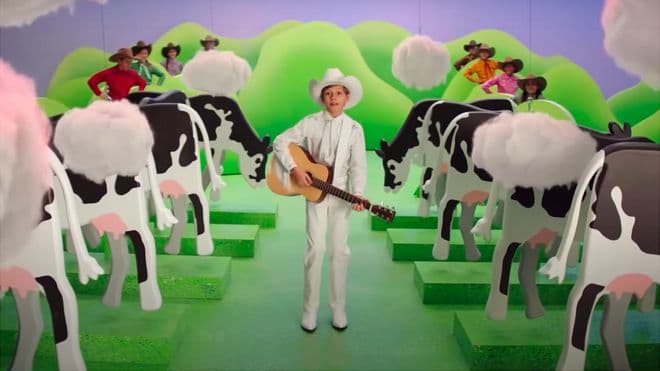
The American fast food chain Burger King has launched an advertising campaign in which American farmers are encouraged to feed their cows differently to reduce greenhouse gas emissions.
In a commercial on YouTube, children wearing cowboy hats sing about the environmental consequences of methane gas caused by cow manure and farts. Burger King claims that adding lemongrass to cow feed eases digestion and can drastically reduce methane emissions.
But farming leaders responded that the global American company's advertising campaign is "condescending and hypocritical."
Promotion
In a study conducted in cooperation with the Universidad Nacional Autónoma de México and UC Davis to develop a new diet for livestock, Burger King said research has shown that supplementing cows' diets with dried lemongrass can reduce methane emissions by an average of 33%.
Hamburgers made from cows on this diet are available this month at Burger King restaurants in many American cities. The commercial is popular on YouTube. So far, it has been viewed by more than 2 million people and has elicited thousands of responses – some mocking the company's marketing with a "yodeling boy," while others vowed never to return to Burger King.
Some scientists also criticized Burger King's message and the focus on the cows' flatulence rather than on the farmers. The National Cattlemen’s Beef Association, a lobbying group, said Burger King was trying to "score easy points with consumers by launching a misleading PR campaign."
Burger King said it "wants to shed light on an issue that is important to the business and industry" and defended itself by noting that the company presents a solution ("cows on a diet") anyway. "The 'Cows Menu' campaign is not something that will solve the climate problem in the short term, but it is a feasible solution that will enable change in the future," the fast food chain said in a statement.
Burger King has been under pressure in the past year as consumers increasingly want to reduce their beef consumption due to concerns about their health and climate impact, the BBC reported in an article about the American hamburger chain.
Professor Ermias Kebreab of UC Davis, who was involved in the lemongrass study, said the core of the defense is sound, but the research is ongoing. "The scientific basis of the study is actually good, but the accompanying commercial is the reason many people, especially in the farming community, were unhappy," he said.
According to the United Nations Food and Agriculture Organization, livestock is responsible for about 14.5% of human-caused greenhouse gas emissions, with cattle representing the largest share.