

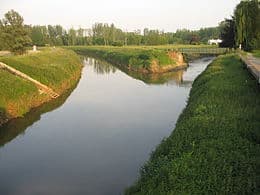
The quality of surface water in Flemish agricultural areas is not improving but continues to deteriorate. And due to over-fertilization, nitrate pollution is not decreasing but increasing. Additional measures are also needed in North Brabant.
Belgium has failed to meet the EU criteria against water pollution for several years, according to the new 2020 Manure Report from the Flemish Land Agency (VLM). Moreover, the EU rules against soil erosion from fields will be further tightened in the coming years.
The reason the water in Flanders is more heavily polluted is that applied manure is not fully absorbed by crops and ultimately ends up in ditch water. In recent years, nitrate levels were too high at nearly a quarter of the measuring points in Flemish streams and rivers.
Promotion
The report shows that compliance with manure legislation needs to improve. Belgium has a ban on fertilizing strips along ditches, streams, and waterways. Last year, more than 380 farms were inspected, and more than half received fines or sanctions.
Supervision of fertilization in the cultivation-free zone along watercourses did lead to fewer violations than the previous year, but violations still remain too high.
The fact that the figures are now heading in the wrong direction does not make things easier for the Belgian agricultural sector. “These are poor results,” says Vanessa Saenens, spokesperson for the Farmers’ Union, to the Flemish broadcaster VRT. “That is unfortunate, because the sector wants to cooperate.”
The dry weather conditions of recent years have undoubtedly affected water quality. The VLM emphasizes that it is the responsibility of every farmer to apply fertilization smartly and properly. Next year, a course will be introduced for Belgian farmers on how to handle fertilization at the water’s edge.
In the adjacent Dutch province of North Brabant, advisors from the ZLTO will visit livestock farmers to prepare a free farm scan against erosion. In addition, the Brabant municipalities, water boards, and provincial government are producing an environmental impact assessment report on clean and suitable areas for manure processing.
The poor nitrate figures come at an unfortunate time for the Flemish agricultural sector. This week, EU countries are discussing Climate Policy at a European summit. Belgium has not yet taken a position on this because the Flemish regional government rejects CO2 reduction.
Calculations circulating within the Flemish government indicate that Flemish farmers could only comply with all EU climate regulations if they reduced their livestock by 40 percent.