

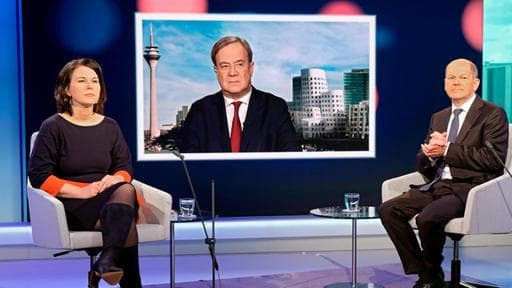
The three German politicians who want to succeed Chancellor Angela Merkel debated with each other on television for the first time. All three question the principle that in the European Union everything must no longer be decided by unanimity.
The three future German leaders have different positions on reforms in the EU, defense policy, and the controversial construction of the Russian Nord Stream 2 pipeline. They also discussed issues such as climate change and Middle East policy during their televised discussion, which was also attended by Merkel and the President of the European Commission, Ursula von der Leyen.
When asked about her biggest complaint regarding the current EU, candidate Annalena Baerbock (Greens) replied that the unanimity principle should only apply to important decisions, and not to less significant matters. Olaf Scholz (SPD) stated that there are certain policy areas where deviating from the unanimity principle might be worthwhile, while Armin Laschet (CDU) cautiously said that he was open to treaty changes.
Promotion
Regarding the controversial Nord Stream 2 project, a second pipeline for Russian gas to Germany, Laschet and Scholz showed much more determination, according to Deutsche Welle.
The project would secure Germany’s energy supply, since the country has phased out nuclear energy, Scholz said, while Laschet said he supported the project and believed it was the “right thing to do.” CDU leader Armin Laschet is largely expected to maintain the diplomatic approach of his predecessor Angela Merkel, showing little nuance on foreign and security policy.
Baerbock, however, took a more critical stance, pointing to opposition against the project from the United States and other European countries. “Germany stands here completely against all other Europeans,” she said. Last year, the Greens called on Germany to halt the project in the wake of the attack on Russian dissident Alexei Navalny.
In Germany, environment and climate change are the two biggest election issues, with the German Greens topping the polls for the first time in their 40-year history. In the most recent opinion polls, the CDU is in second place, the SPD third, and the AfD, Die Linke, and the FDP close together in fourth, fifth, and sixth place.
Scholz tried to bolster the green reputation of his SPD, claiming that his party had pushed for stricter emission reductions and advocated for more renewable energy. Meanwhile, Laschet pointed to the coal phase-out agreed upon under the conservatives. The coal phase-out in Germany is scheduled relatively late, in 2038.
Green candidate Baerbock criticized the course of the SPD and CDU on climate issues, questioning why, if the other parties cared so much about the environment, Germany’s progress toward climate neutrality had stalled so much under their watch.