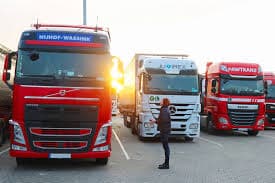
Great Britain plans to grant work permits again to several thousand Eastern European truck drivers, barely a year after 25,000 foreign truckers had to leave the country due to Brexit.
Petrol stations in England are complaining about supply shortages, and stores are increasingly struggling with empty shelves due to disrupted deliveries.
Transport organizations and retail chains have warned the British government of even greater problems ahead of Christmas shopping, stating that at least 100,000 new truck drivers are needed. Prime Minister Boris Johnson, who is at the UN in New York this weekend, is expected to announce the temporary work permits on Monday according to British media.
British newspapers reported that the government would allow 5,000 foreign drivers into Great Britain on a short-term visa, something the government had previously ruled out. The driver shortage has not only been caused by Brexit, but also by the COVID-19 pandemic and the loss of about a year’s worth of driver training.
Since leaving the European Union, agriculture and horticulture in particular, as well as the meat processing industry, have been facing severe labor shortages. These sectors largely depended on hiring (cheap) temporary seasonal workers, mainly from Central and Eastern European countries. Partly for this reason, British import and export volumes have decreased significantly and freight transport across the country is experiencing capacity problems.
The looming fuel shortage at many petrol stations coincides with Great Britain, the world’s fifth-largest economy, also struggling with a peak in European natural gas prices, leading to rising energy costs and potential food shortages.
Due to the shortage of truck drivers, milk is no longer being collected everywhere from dairy farms, forcing some farmers to discard their milk.
The retail sector has warned that unless the government takes measures to address the shortage within the next 10 days, significant disruption is inevitable in the run-up to Christmas. The transportation sector currently says it needs approximately 90,000 additional drivers.
Supermarkets and farmers have called on the government to resolve labor shortages in crucial sectors. Besides truck drivers, this also concerns staff in the processing industry and agriculture. These labor shortages in those sectors have put the food supply chain under pressure, they say.