

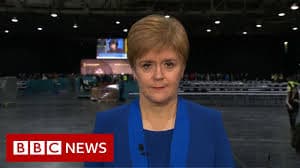
Scotland must have a new referendum on independence. That is what Scottish First Minister Nicola Sturgeon of the Scottish National Party (SNP) wants. Her party, alongside the Conservative Party, was a winner in last week's British elections. But Boris Johnson has already made clear that he is not in favor of this.
The SNP won 48 of the 59 Scottish seats in the House of Commons in London, a gain of 13 compared to 2017. 'There is now a mandate to offer the people of Scotland the choice about our own future. Boris Johnson may have a mandate to take England out of the European Union. He does not have a mandate to take Scotland out of the European Union,' said Sturgeon.
The political developments over recent years have caused significant division in Great Britain. For example, England and Wales voted in majority for leaving the European Union in the 2016 Brexit referendum, while Scotland and Northern Ireland wanted to remain EU members. Moreover, there has been a long-standing movement in Scotland advocating independence.
Promotion
British Prime Minister Boris Johnson is firmly opposed to a Scottish referendum on independence. He stated that the result of a Scottish referendum in 2014, in which separation was rejected by 55 percent, must be respected.
This threatens to create a similar situation for British politics as in Spain, where the autonomous region of Catalonia advocates independence and two years ago held a referendum without Madrid's government's permission. Scotland requires the consent of the House of Commons in London to hold a referendum.
Johnson therefore insists on a previous Scottish referendum. According to the SNP, the situation is now different because remaining in Great Britain also means that the Scots will be taken out of the EU through Brexit. Sturgeon said that the mandate her party received from the Scottish population "must now be respected."
Moreover, the new Conservative government under Prime Minister Johnson will, from the very beginning, face concerns or opposition from Northern Irish political parties, because Johnson’s Brexit deal with the EU places Northern Ireland more or less outside the British but inside the European customs area.
This seems to shift the previous rift among the entire British population (for or against Brexit) in the coming years to new divisions: Scotland inside the UK but outside the EU, or Britons without Northern Irish and Scottish members outside the EU.